
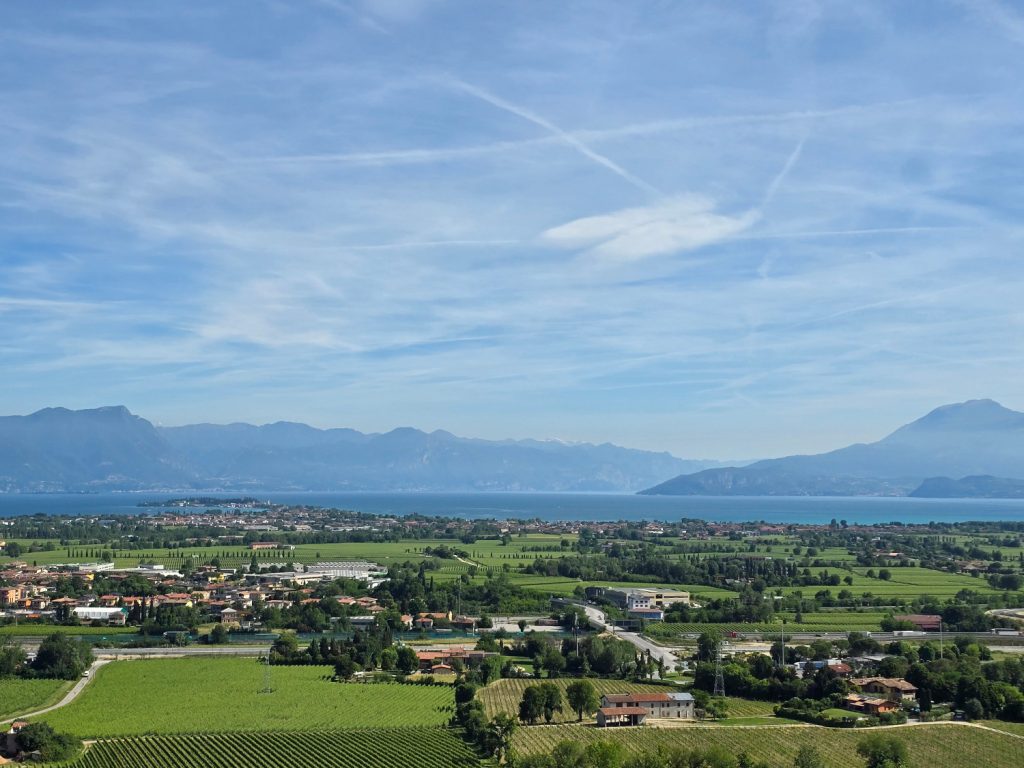
From the southern shores of Lake Garda, Italy’s largest lake, Robin Goldsmith loads up on Lugana and savours a tantalising trio of tannins, acidity and salinity, served up with freshness and clarity. A version of this article was originally published on The Write Taste.
Lugana DOC, which encompasses five municipalities, lies on the southern shores of Lake Garda, the largest lake in Italy. It’s one of the few wine regions that straddle two provinces – Brescia and Verona – and two regions – Lombardy and Veneto. It’s small, measuring only around 7 miles east-west and 5½ miles north-to-south.
Lugana has had a long history of winemaking since at least the second century BCE and there are now approximately 2,600 hectares of vineyards here. The lake itself was formed by glacial activity more than 10,000 years ago. This created morainic hills with soils rich in glacial debris, clay, limestone, mineral salts and sand. The land is generally low-lying, usually under 100 metres above sea level.
Cooling breezes from the north and south blow across the lake, moderate the climate and help ward off disease in the vineyards. Mountains on either side offer further protection from adverse weather. So, with good levels of sunlight too, conditions are ideal for the early-budding, late-ripening Turbiana grape, mostly grown on north/south-facing, Guyot-trained vineyards. Grapes are typically hand-harvested and massal selection is often used.
A region rich in biodiversity, over 60% of wine production is sustainable or organic and many vineyards are surrounded by natural woodlands.
Turbiana
Once thought to be part of the Trebbiano family and, indeed, previously known as Trebbiano di Lugana, DNA research has shown that Turbiana is closely related to Verdicchio, but with its own distinct characteristics.
These include high acidity, compact clusters and thick skins, the latter giving some tannic grip to the resultant wines. High levels of tartaric acid lend freshness to young wines and enable reserve wines to age for up to a decade or more. The grape is, therefore, extremely versatile for still and sparkling wines, with excellent food compatibility throughout a meal. As well as citrus, orchard or tropical fruit flavours, a savoury character is often present too, along with an almondy finish.
There are five categories of Lugana wine – Spumante, Lugana DOC, Lugana DOC Superiore, Lugana DOC Riserva and Lugana DOC Vendemmia Tardiva. The DOC requires a minimum of 90% of the Turbiana grape in any blend, with the remaining 10% coming from other authorised white grape varieties. However, most wines are made from 100% Turbiana.
What does Lugana wine stand for?
For every producer, Lugana’s true identity has a different emphasis, but these are all joined by a common thread.
An acidic spine
For Cynthia Chaplin, Italian wine specialist and sommelier, acidity is central to the Turbiana grape’s identity: “This is a grape that really does have an acidic spine, a propensity for lovely, rich, ripe fruit, but it’s not unctuous. It’s not cloying or heavy and is more sophisticated with age than we would suspect.”
Le Morette in Peschiera del Garda showcases Turbiana’s acidity beautifully. For example, their Trentaseimesi Metodo Classico Brut is a sparkling wine made from 70% Turbiana and 30% Chardonnay, with 36 months on its lees. Notes of lemon, peach, breadcrust and almonds on the nose carry on to a fresh, mineral palate with good length and bright acidity.
Another winery where acidity is seen as the main identifying component of Lugana wine is Perla del Garda, the only producer making all five styles of Lugana. Located in Lonato del Garda, in the southern part of Lugana, they harvest two weeks to one month earlier than vineyards closer to the lake, as grapes ripen earlier here. Perla del Garda Brut Nature Magnum 2013 is a delightful, easy-drinking sparkler. The nose is floral with nectarine, white peach, grated almonds and a gentle bready character. The palate is similar with added notes of yellow apple, zingy citrus and buttered croissant with a touch of salinity. Spending ten years in magnum, it still shows vitality, maintaining impressively fresh acidity.
Tannins are the key
For Alessandro Cutolo, owner and winemaker of organic-certified Marangona, the key to Lugana wines is tannins. “I love tannin in white wines,” he says. “It’s maybe the most important aspect of our wines – more than sugar or acidity. We are lucky that we work with old vines, so the ripeness of the tannins is guaranteed.”
Fermenting and ageing in cement, which they do for their flagship wine, Marangona Cemento Lugana DOC, allows for micro-oxygenation without adding unwanted oak flavours. Grapes are de-stemmed and fermented with their skins for a few days in concrete tanks to extract more tannins. The wine is left to age on its fine lees for 10-12 months, before staying in the bottle for at least another six months. “We want the balance between acidity, tannin and the creaminess that comes from ageing”, explains Alessandro. “So it’s a classic white wine with more tannins than normal. It’s not typical and you can see how the texture balances with the acidity of the fruit.”
On the nose, the 2022 vintage shows touches of lemon, pear, apple and herbs. The palate achieves Alessandro’s aim of balancing acidity, tannins and creaminess with a fresh mouthfeel, rich fruit notes of orchard and tropical fruit, a touch of chalkiness plus a soft, saline and savoury edge.
Salinity
One of the other characteristics noticeable in so many Lugana wines is salinity, as is demonstrated perfectly at Ottella winery. The 90-hectare family-owned estate, located in Peschiera del Garda, is an integral part of the region’s history. It’s documented as the only producer of Lugana as far back as 1905. Three years before the DOC was founded, the first map of the appellation was created in 1964 by Lodovico Montresor and two other notable figures of the area.
The modern, state-of-the-art winery is designed with characteristic Italian style and flair, but takes it to dazzling heights. Montresor was an art lover and collector who transmitted his passion to his children. So German artist, Julia Bornefeld, has created several pieces of art for the winery building, linking the beauty of art with the beauty of the wine.
Le Creete is a single vineyard, unoaked expression made from one of their oldest sites. “Salinity is one of the main characteristics of our wine,” explains fifth generation Lodovico Montresor. “For Le Creete, we prefer to use stainless steel and concrete. In this way, we focus more on freshness, fruitiness and salinity.” Indeed, the 2024 vintage has a salty and savoury tang on the nose, which complements the tropical fruit notes and a touch of citrus. These continue on the intense, rich, mineral and complex palate, which also shows a hint of baked apple.
A light touch
At Avenzia, a family business created in 1931, a light touch to winemaking, including where required, careful use of oak is clearly important. The grapes for their Lugana di Sirmione DOC come from the clay-rich Vigna Bragagna estate in Sirmione. Uniquely, they are the only winery in Lugana allowed to display the name ‘Sirmione’ on the label.
Gentle, whole bunch pressing and fermentation in stainless steel tanks are used to create this gastronomic style of wine with low residual sugar. The nose has a slight chalkiness with fruity notes of pear, apple and citrus. The palate is textural with notes of bitter lemon, orange, peach and green almonds with a salty, mineral backbone. Three months of lees ageing with regular bâtonnage has added complexity and a soft touch. At only 12% ABV – previously vintages have reached 13.5% – this wine shows plenty of Lugana character and finesse, matching perfectly with the local fish soup.
Freshness and clarity: bringing it all together
At the heart of all Lugana wines is freshness and clarity. Citari winery is located on the historic hill of San Martino della Battaglia, near the tower of the same name that commemorates the 1859 battle that led to the unification of Italy. Vines of up to 55 years old lie at the highest point of the area (approximately 265m), on the last morainic hills before the start of the low-lying plains.
For Francesca Fiorentini, Lugana’s wine identity is clear. “You can find a common thread in all the producers,” she says. “There’s freshness, acidity and minerality, of course, because these are notes that are intrinsic to the grape itself, but for us, it’s cleanness. We want to offer something that is really pure, clean and clear – wines that are like knives in the mouth, very straight, fresh and easy, but persistent and with bite.”
Citari Conchiglia is their flagship wine, named after the fossils contained within the limestone and clay soils of the area. It represents the philosophy of the winery. “This is the first wine we made and it basically reflects our idea of what Lugana and the area are for us.” The 2024 vintage shows citrus, white peach and apple notes on the nose, which follow on to the palate with a saline, sapid bite and a hint of tropical fruit. There’s a great balance of acidity in this wine and, unsurprisingly, it’s won a catalogue of awards since 2009.
Lugana wine: one grape with linked identities
Each producer interprets the identity of Lugana in their own way. There are many expressions, but these are all linked by freshness, acidity, tannins, salinity and a clear, clean mouthfeel that allows the grape’s inherent characteristics to shine. Oak influence is subtle where used, the wines are extremely versatile with different cuisines and they can age very well too. Also, local prices are incredibly affordable, showing an amazing cost-value ratio, with many coming in at under €15 a bottle.