
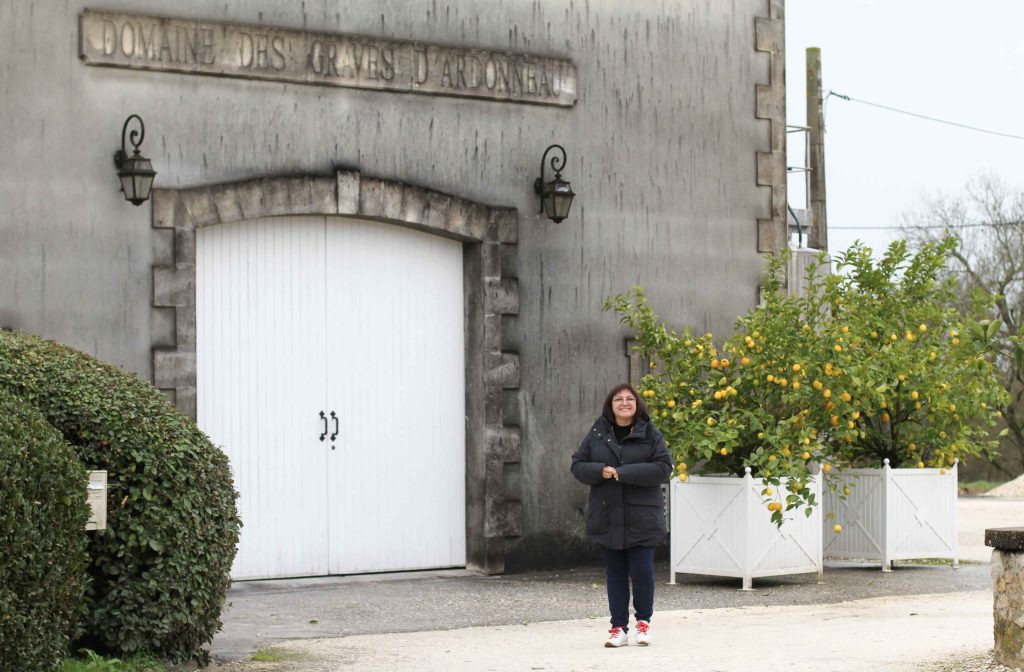
In our online Circular seminar on the crisis facing French vignerons, Helen Savage, sets the scene by showing the seriousness of La crise viticole, before concentrating on case studies on how three wineries are faring. A highlight of the session is Helen’s interview with Fanny Rey of Domaine des Graves d’Ardonneau, who left the prospect of a career as an opera singer behind to return to a family winemaking fold that dates back to 1783. Here is Helen’s write up of the session, held on April 28, which can be viewed online.
The French wine industry is facing a highly uncertain future, whereby wineries of all shapes and sizes are going out of business. There are three main reasons for the current crisis. The first is climate change, which has resulted in five catastrophically small harvests in a row in South West France. The second is a marked drop in consumption (in France roughly 3-4% year-on-year, while global wine consumption is at its lowest since 1961); and the third reason is tariff wars which have deeply affected both the US and Chinese export markets.
In October 2024, Bernard Farges, the president of the CNIV, the body that represents wine growers nationally, admitted that ‘overall, business is bad: the crisis is both structural and cyclical’. The French government has responded by funding a grubbing up campaign to try to reduce supply to match demand, to accelerate and boost innovation, to revive consumption, and to set greater export targets. The plan is for 100,000 hectares to be grubbed up, out of more than 750,000 hectares (ha) of vines in France as a whole. In November 2025, €130 million was made available, which is sufficient to remove 32,500 ha of vines.
Agriculture Minister Annie Genevard argues that: ‘This significant new financial commitment demonstrates the government’s determination to save our wine industry in the long term and enable it to bounce back. [It is] not just another emergency plan [but] an investment to give our wine industry a future.’
By April 17, it was reported that 5,823 vignerons had applied to take part to remove 27,926 ha of vines, with smaller producers mostly attracted to the programme. Over the previous two years, 27,000 ha of vines have already been removed with government aid, but even more than that have been grubbed up overall. For example, the Bordeaux vineyard alone has shrunk from 119,000 ha in 2019 to 92,000 ha today.
But there is not yet enough hard data available to measure how effective the programme is proving. There is little clear information, for example, about the impact of the crisis on wine merchants, restaurants, and most importantly from the perspective of this study, direct, or farm-gate sales.
In November, Jean-Marie Fabre, the president of the syndicate of France’s independent winegrowers pleaded for urgent action to save up to a fifth of France’s winegrowers. To achieve this, Bernard Farges believes that the industry needs to be more innovative. Nothing should be taboo and that without necessarily going down the route of de-alcoholised wines – fresher, lighter wines, as well as wines with less tannin are two ways to attract new consumers.
What kind of advice is available, then, to winegrowers trying to keep their heads above water?
The NG Vin Training Centre, which offers a wide range of courses to industry professionals in the Rhône Valley, provides a model. They suggest that there are three key factors that wine businesses must take into account in order to secure a profitable future. The first is to think about the market before deciding about products. The second is to develop a coherent commercial strategy, which is surely an essential factor in any successful business. The third is to add value, and maybe diversity, to the business by the means of wine tourism.
Case Studies
This is a case study of three businesses, each very different, all working hard and imaginatively to maintain profitability. My aim is to explore some of the challenges they face, with reference to the causes of the current crisis, together with the three factors for success suggested by NG Vin. The first case study is in Bordeaux, away from the spotlight of the classed growths. The others are in the neighbouring appellations of Bergerac and the Côtes de Duras.
Domaine des Graves d’Ardonneau
Domaine des Graves d’Ardonneau is in Saint Mariens in the appellation of Blaye Côtes de Bordeaux, run by Fanny Rey with her brothers Christian and Laurent, who were chosen by the 2025 Guide Hachette as Bordeaux winemakers of the Year.
There are few signs of grubbing up in progress around Saint Mariens. Fanny told me of just one property in the commune which has chosen to join the scheme, but that is mainly because the vigneron there needs to retire and nobody is available to take over the estate; but as she pointed out further north in the appellation, closer to the town of Blaye itself, it’s a scene of utter ‘desolation’. The same could be said of parts of Côtes de Bordeaux Sainte Foy, just across the road from the Domaine des Allégrets, to which I’ll turn, a little more briefly, later.
Fanny is not convinced that it’s right or often possible to think about markets before products. ‘We’re not particularly into trends,’ she says, adding that her grandfather always insisted that trends go out of fashion as quickly as they appear. In the 1960s, white varieties were grubbed up locally and replaced with red, but Fanny’s grandfather rightly, she believes, remained convinced that white wine would one day again sell better than red. She prefers to stick with the varieties traditional to the area, has little interest in natural wines or orange wines and is emphatically dismissive of alcohol-free wines: ‘[Alcohol-free wine] makes my hair stand on end. It’s a product associated with wine, but it’s not wine.’ She emphasises the value of flagship wines, such as a special bottling of ‘exceptional micro-vintages.’
What then, about the second factor for sustainability: the need for a coherent commercial strategy? Fanny handles the commercial side of the family business. Her personal story helps understand the commercial decisions she makes. She admits to having had little interest in wine or the family estate, but decided to follow a course in business studies in Bordeaux, whilst also taking singing lessons at the conservatoire in the city. She was (indeed is) hugely talented and a glittering career on the opera stage was a real possibility.
She had no ambition to make wine herself, but unsure of her future, wondered if she might be able to sell the estate’s wine abroad. She did internships in Germany and England in the hope she might learn how to set up sales outlets there – no easy task. While in Germany, aged 18, she began to taste wine seriously for the first time, discovered that she has a good palate and on returning home asked her father if she could taste all the lines offered by the family. The penny dropped. She also got stage fright. She decided to join the business with fresh enthusiasm and try, as she says, to help it move forward.
Below-par Blaye in a bar brings opportunities
New opportunities came while she was still studying. There was a tradition that conservatoire students enjoy a drink together after class. In their favourite bar, she tasted a wine from Blaye and pointed out to a friendly waiter that her family’s wine was far better. The owners agreed to taste it, liked it and decided to stock it. Another bar owner discovered it and liked it so much that he showed it to some Vietnamese clients, who found a way to make a modest order. She still sells wine to Vietnam. Most other exports are to mainland Europe.
Sales for the Rey family are predominantly to a wide base of individual, private customers – 70% of the total production. In addition, 15% is sold to the trade in France and 15% is exported. Fanny insists that word of mouth matters. She has discovered that it has the potential to bring in the individual customers who are the bedrock of her business today.
She also stresses that securing client loyalty can no longer be taken for granted. Customers today can be very volatile. ‘They’ll spend a year with a new winegrower, but it’s not certain they’ll come back.’ And so, she argues, ‘to build their loyalty, we focus on consistent quality and consistent prices’ – a key element is the need for a coherent commercial strategy. ‘This year’, she admits, ‘we’ve been forced to increase prices a little more than in other years – around 15 centimes per bottle. For us, that’s huge.’ But they have not increased the price of the bag-in-box offer for three years.
The size of the property (70 ha) is critical. Economies-of-scale help greatly, as the grubbing up figures testify. Or to put it another way as Fanny herself suggests, ‘we focus more on quantity sold than on price’. The Rey family support this by working hard to ensure that other costs, such as increases in transport costs and packaging are not automatically passed onto the consumer.
Fanny is bluntly critical of competitors who have been quick to raise prices, sometimes substantially, in recent years. She believes that those who hiked their prices after every rise in production costs lost customers.
‘Only spend one coin when you have two’
The Rey family practices a very conservative approach to the funding of the business: ‘only spend one coin when you have two’. They avoid borrowing as much as it’s possible, especially expensive bank loans. The goal is to invest money back into technology to improve the quality of the wine they offer.
They believe that a key factor in maintaining customer loyalty is consistent quality, even if this means withholding wines that are not worthy of the label, as happened in 2013. Put simply, Fanny insists that such an approach may be characterised by honesty – a quality she believes is essential in running a truly successful business.
In order to maintain contact with customers, the estate sends out regular newsletters electronically and in the post, and maintains generous opening hours. The family try to make every customer feel valued, even if they buy just three or four bottles.
Fanny’s parents also maintain contact with a number of customers through a modest programme of participation in relatively small, local wine fairs, especially in western France, two or three hours away. This is achievable only because they have time to devote to this kind of selling. It is not a long-term element in the success of the business, for as Fanny says bluntly, fairs are dying out. The best way to find new customers remains word of mouth and then to establish as warm a connection with customers as possible. And the bottom line is that sales to private customers maintain the greatest margins.
Labelling for the trade
In order to maintain integrity of the offer to private customers, all the wine sold in France to the trade is labelled differently. Since 2009, two wines have been available exclusively to the trade, sold as ‘Château la Croix du Lys’. Production costs are kept as low as possible to maintain margins, but the aim is to enable the trade to sell one wine at a price similar to that of the wines available to private customers, and one that’s significantly cheaper.
Finally, what of the third factor for sustainability suggested by NG Vin, wine tourism?Fanny’s firm belief that it is essential to focus on the estate’s core business strategy which, as it stands, leaves little room for diversification. She admits that she has been tempted to use one family property as a gîte, but then came to the conclusion that it was not a practicable proposition.
It’s clear that Fanny and her family know their market intimately and supply what it wants, matched by a thoroughly well-defined commercial strategy. And it works well.
From Blaye to Monbazillac
In Bergerac, or more properly the appellation of Monbazillac, roughly 90km to the south west of Saint Mariens, the Metifet family think a little differently. Their estate is a similar size to Graves d’Ardonneau with 75 ha, but it is farmed organically. For Laurence and Philippe Metifet wine tourism is an essential and growing part of their business plan, along with an increasingly diverse offer of wines. That apart, there are also some striking similarities with Graves d’Ardonneau, not least the customer base, with 70% private sales, 20% trade and 10% export. Just as with Graves d’Ardonneau, a second label is dedicated exclusively for trade sales.
Other similarities include regular mailings and a commitment to giving time to clients when they arrive at the cellar door. The backbone of their offer is AOP wines from Bergerac, Côtes de Bergerac and Monbazillac, but they have been more open to experimentation, offering, for example, a varietal, barrel-fermented Chenin Blanc, an Orange wine and a Pét-Nat sparkler. Laurence insists that these wines do not just appeal to younger clients: there is a significant market for those who prize both local and organic products. She is not tempted to try new PIWI resistant varieties, but is more open to other varieties not traditional to the area, for example, Chardonnay and Touriga Nacional.
No to zero-alcohol wine
Like Fanny, Laurence dismisses the idea of zero alcohol ‘wine’ commenting that, ‘it would be better to stick to grape juice.’
Even more than at Saint Mariens, fickle weather provoked by climate change has been the greatest challenge to profitability. In 2024, 90% of the crop was lost to hail and the books had to be balanced with the help of €20,000 prize draw. The same summer, the family employed a social influencer to boost their presence on the internet and to attract new customers. She made quite an impact with videos achieving up to 25,000 views.
Like the Rey family, the Metifet family have valued the contact with loyal clients afforded in the past by small, local wine fairs (something that Fanny’s parents take responsibility for), but eschew larger fairs which, as Laurence points out, are attended often by those with a strong interest only in finding novelties.
Full-on wine tourism
The most striking difference between the two estates is the Metifet’s whole-hearted embracing of wine tourism. Their offer includes guided tours and tastings, including blind tastings, brunches, informal evenings with food and live music, as well as ‘wine gaming’ – a cunning mixture of wine education and team building. They find that such events are particularly attractive to tourists and second-home owners, who then become regular customers and receive regular monthly mailings and news of special promotions.
Future plans include the possibility of a top-class restaurant on site. The bottom line for Laurence is that ‘we need to do something apart from just producing wine.’ But a personal touch is hugely important. It is not for nothing that the estate’s slogan is ‘Cultive le vin. Récolte les rencontres’ (‘make wine, harvest the encounters.’).
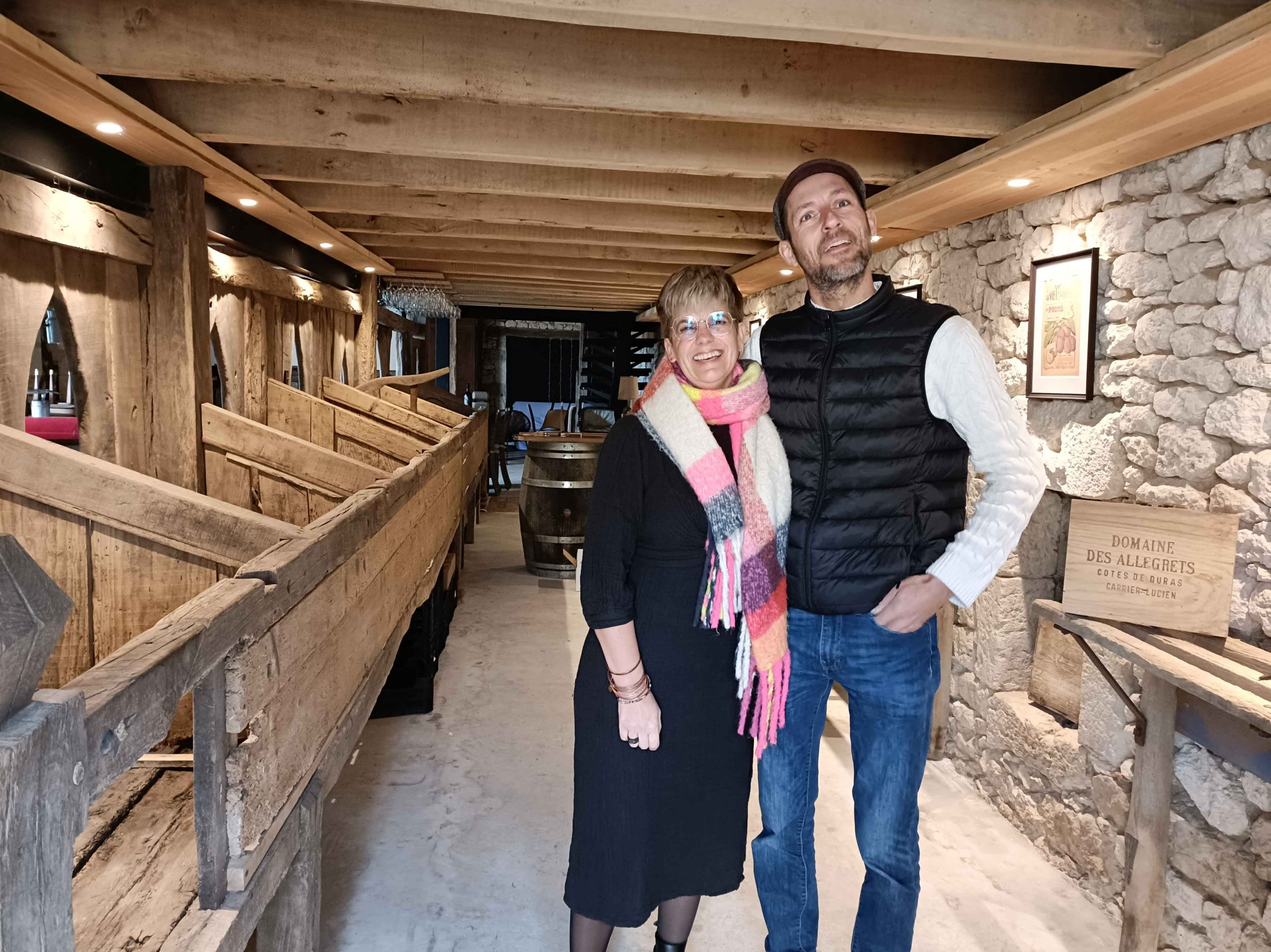
My third example is less than 20 km away, just across the departmental border into the Côtes de Duras, where Julien Blanchard of Domaine des Allégrets has 23 ha of vines cultivated organically and 8 ha of plum trees, from which he produces top quality pruneaux d’Agen. Around 60% of his sales are to private customers, with most of the rest sold to the trade.
Embracing experimentation with abandoning the brand
Like Laurence Metifet, Julien is keen to experiment with new styles of wine, especially Orange wine and Natural wine. He is open to experimenting with some new varieties including new resistant varieties, but having worked hard to promote the local appellation, he is reluctant to abandon a brand which he feels means a lot to many of his existing customers. For him too, it is not simply a matter of putting market before product.
Climate change has also hit him hard, with around 70% loss of crop in recent years. His business plan depends on having sufficient stock in hand to meet demand, but this is fast diminishing.
The greatest problem he faces is that so much depends on him alone. It is one thing to make wine, it is altogether another to have to sell it and time is limited. Just as in the strategy of the other two studies, his parents depended greatly on local wine fairs for sales: up to a dozen between Rennes in the north and Toulouse in the south. When a recent illness prevented him from taking part in the annual round, Julien wrote to established customers to ask if they would like wine delivered. None replied. Fairs are no longer part of his plan.
Engaging with consumers on home turf
For the last three years, he has been concentrating more effort on regular consumer events, which take most Friday evenings, with occasional, longer ‘festive’ weekends in a converted building on the estate – named after his centenarian grandfather, ‘Lulu’s Wine Barn’. He and his partner have tried to create an intimate atmosphere in which a wide variety of food is served in partnership with local producers, live music, quiz nights, the opportunity watch major sporting events and, of course, an opportunity to enjoy and buy wine from the estate.
The clientele is younger than those who bought from fairs, with an average age of around 50 and is made up half of locals and half expat Brits. The success of Lulu’s has been through word of mouth. Satisfied customers tell their friends. They become brand ambassadors. Although he notes that younger consumers are attracted to his alternative products, especially Natural and Orange wines, the context of Lulu’s, enables other customers to discover how good they can be. They then buy them.
The sheer effort of trying to fulfil different roles causes him to wonder what steps he should take next. He is not short of ideas, but notes, for example, that although he is deeply committed to the philosophy of organic wine production, which costs more, he doubts that his most loyal customers would notice if he reverted to a conventional methods of production. He is minded to reduce his workload in the vineyard by reducing the number of hectares under vine and to stop selling wine to the trade, which he finds time-consuming and unprofitable. He will then try to further increase the quality of a smaller production aimed specifically at individual customers.
Conclusions
The strength of case studies lies in their particularity. Although they have no statistical significance, they are much more than an illustrative device. They can be used to qualify or disprove general statements, raise and refine questions and, it may be hoped, suggest new insights.
Of the three factors for a profitable future identified by NG Vin, the advice to put markets before products is not an easy starting point for long-established businesses, especially those earthed in and often highly committed to the notion of a protected designation of origin. But all three case studies demonstrate that it is the quality of their products that is indispensable, whether or not new products are also added to entice new markets.
All three have embraced a coherent commercial strategy, albeit in rather different ways. Such a strategy is indispensable. The example of Graves d’Ardonneau shows that a very traditional estate, run well, can still keep afloat, the other two properties, whilst also embracing that principle, have come to rely on a greater diversification of their offer, both in what they sell and how they go about it. For Haut Monlong and Domaine des Allégrets, wine tourism is now an integral and essential element in their continued success.
All three businesses have been hit by climate change and the decline in consumption of wine, but all three have avoided the perils of export tariff changes by concentrating on expanding their local, individual customer base. Where a winery is situated inevitably has a considerable impact on its chance of success. However, it is not necessarily the case that independent growers in unfashionable or overlooked appellations face a greater challenge than those in the most prestigious appellations.
If there is any further common characteristic for success, it is the recognition that in a declining market it is increasingly hard work to find new customers and to keep established clients, but sheer force of personality and self-belief goes a long way to counter this. It shows that even estates in less fashionable regions may be surprisingly and encouragingly resilient.
Photos by Helen Savage:
Fanny Rey at Domaine des Graves d’Ardonneau
Domaine des Allegrets