
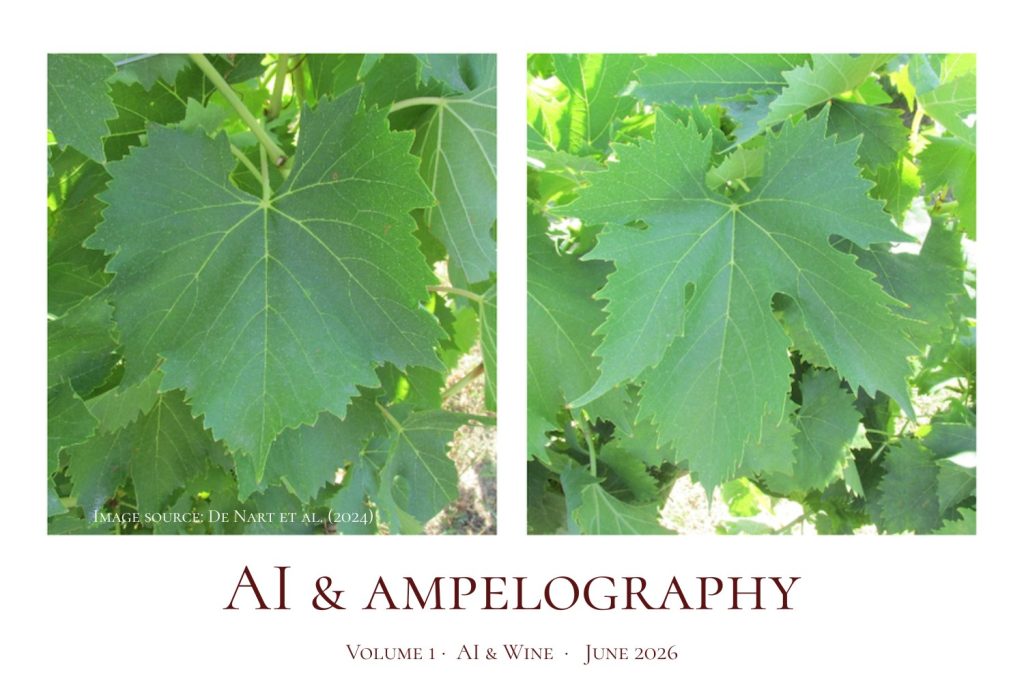
From DNA to data, artificial intelligence is beginning to read the vine, according to grape geneticist and ampelographer Dr José Vouillamoz, who also explores whether it will also decide its future. The possibilities are boundless, with an electronic nose already being used to classify cultivars, and Vouillamoz, one of the world’s leading authorities on grape variety origins through DNA profiling, even anticipates a vine identification app, to which Circle members could even contribute.
Artificial intelligence fascinates me as much as it worries me, yet its potential in the study of grape varieties is extraordinary. Ampelography, the science of grape varieties description and identification, is based on the observation of the shape of the leaves, shoot tips, bunches, and berries. But classical ampelography has its own limits, and very often, DNA profiling came to the rescue. Carménère was grown and sold as Merlot in Chile for over a century. Savagnin Blanc was marketed as Albariño across Australia for years. Kolorko, an obscure variety from Thrace in European Türkiye, turns out to be genetically identical to Furmint, the great grape of Tokaj — a discovery I published only this year (Vouillamoz, 2026).
Today, after having mapped grapevine diversity through DNA, a new tool has arrived — one that promises not only to identify and understand varieties, but also to predict which ones should survive the century ahead — Artificial intelligence (AI).
Grape identification
Image recognition
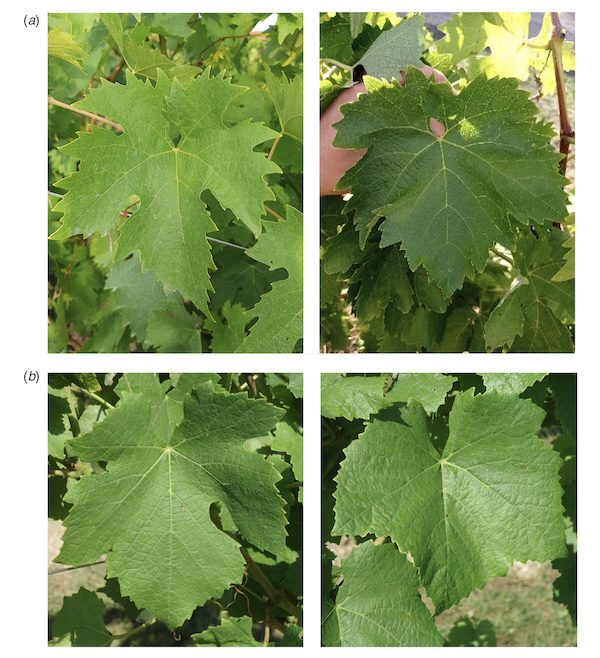
The most obvious application of AI to grape varieties is in image recognition. Classical ampelography has its own limits: you cannot generally identify a plantlet before its first harvest, a virus can distort leaf morphology beyond recognition, and there are nearly 10,000 grape varieties in the world — including table grapes, raisin grapes, and rootstocks — that no single ampelographer could ever know by sight (Robinson et al, 2012). Deep learning models are beginning to fill that gap. A 2024 systematic review of 37 studies found that machine learning approaches, most relying on leaf images, already show impressive accuracy under controlled conditions (Cunha et al, 2024). A large-scale study across five different models confirmed robust classification was achievable even in real vineyard conditions. One study reported 99% accuracy for variety recognition in the field (Franczyk et al, 2020).
Hyperspectral imaging
What interests me even more is hyperspectral imaging combined with AI. Unlike a standard photograph, hyperspectral images capture data across dozens of wavelength bands invisible to the human eye — encoding varietal information in the leaf’s pigments, wax structure, water content, and internal anatomy. No ampelographer can access this. AI can, and training models on such data may eventually allow identification at a level of precision exceeding any human expert.
The difficult case of clones
The next frontier is more delicate still: clone identification. Different clones diverge in bunch compactness, yield, ripening, bunch size, berry shape, aromatic expression, and even berry colour. Distinguishing Pinot Noir clones from one another is something standard DNA markers cannot reliably do. Hyperspectral imaging has already been used to discriminate grapevine clones from leaf reflectance data alone (Fernandes et al, 2015). If a clone leaves a faint optical fingerprint on the leaf, AI may be able to read it.
Beyond imaging
AI is not limited to photographs. One study applied an electronic nose — sensors detecting volatile compounds from leaves — to classify five grape cultivars. The best models reached around 99% accuracy (Khorramifar et al, 2022). Furthermore, the grape varieties were recognised not by their shape, not by their DNA, but by the scent of their leaves. A machine nose for ampelography.
The seductive myth of instant identification — and its limits
Most current models work in controlled conditions, on limited datasets, covering a fraction of global grape diversity. Take them into a real vineyard — old vines, mixed plant material, different training systems, different seasons — and accuracy drops sharply. The models perform best on the varieties for which they have the most training images: the familiar international cultivars. They struggle precisely where we need them most, in old vineyards which are full of forgotten, obscure, or unrecorded varieties.
A wrong identification delivered with 96% confidence is more dangerous than honest uncertainty. AI must give probabilities, not verdicts: this looks like Pinot Blanc, but could also be Chardonnay; this profile is unknown, but closest to this family.
Breaking the bottleneck: how AI facilitates grape breeding
Traditionally, breeding a new grapevine variety is an incredibly slow process, often taking more than 20 years from the initial cross-pollination to the commercial market launch (Herzog, 2025). While geneticists successfully use Marker-Assisted Selection (MAS) shortly after germination to identify specific genes for mildew resistance, MAS falls short when dealing with highly complex, polygenic traits governed by many loci, such as drought tolerance, yield architecture, and subtle aromatic profiles (Magon et al, 2023).
This is where the ‘phenotyping bottleneck’ occurs. Breeders have to manually observe and measure thousands of seedlings over several seasons to see how they perform. AI is completely dissolving this bottleneck through High-Throughput (HT) Phenotyping (Herzog, 2025).
Using automated sensor data, drones, and RGB imaging (a digital image composed of pixels, where each pixel is defined by a combination of three color values: Red, Green, and Blue), AI algorithms can process massive datasets to evaluate major categories of traits simultaneously (Herzog, 2025):
- Morphology: automatically measuring the dimensions and spatial arrangement of grape bunches, and shoot uprightness under unpredictable field conditions.
- Yield Components: counting flowers and tracking early grape bunch development at an early stage to predict crop loads.
- Disease Resistance: spotting the earliest microscopic symptoms of downy or powdery mildew, quantifying the exact severity, and predicting disease progression across thousands of experimental cross-breeds.
By automating these observations with machine learning, breeders can implement ‘predictive genomics’ (Brault et al 2024). AI links the genetic code of the vine to its actual, real-world physical behavior, allowing scientists to select the winning climate-smart seedlings in a fraction of the traditional time (Herzog 2025; Magon et al. 2023).
Climate change and the reshaping of grape varieties
AI will play a defining role in how grape varieties will survive the climate change shift. To achieve long-term sustainability, viticulture must adopt better-adapted varieties (Herzog, 2025).
PIWIs (Pilzwiderstandsfähige Rebsorten)
A primary solution lies in PIWIs (Pilzwiderstandsfähige Rebsorten), which are hybrid varieties specifically bred for high fungal resistance, reducing fungicide use by 50% to 80%. Historically, only a few PIWIs (like Calardis blanc) were built to handle both fungal pressure and climate stress. Today, global breeding programs are using AI to actively select new PIWI cultivars that combine multiple disease-resistant genes with strict heat and drought tolerance, all while ensuring the final wine meets premium quality standards.
Unlocking ancestral germplasm collections
Every major wine-producing region holds ex-situ germplasm collections, which are living archives of thousands of varieties, including rare, forgotten, and autochthonous grape varieties (Magon et al, 2023). These collections represent a vital reservoir of genetic heterogeneity that holds the key to climate resilience. AI allows us to rapidly screen these massive collections, using automated data analysis to identify obscure varieties with high water-use efficiency or late-ripening cycles. Once identified, these heritage grapes can be reintroduced to their native regions to combat warming climates, or used as parents in predictive breeding programs.
Genome editing in the vineyard
In September 2024, Italy hosted Europe’s first open-field trial of genome-edited grapevines: a DNA-free CRISPR project targeting reduced downy mildew susceptibility in Chardonnay. Separately, CRISPR/Cas9, what could be called a ‘genetic PhotoShop’ for plants, has been used to improve resistance to Botrytis cinerea, one of viticulture’s most damaging fungal diseases (Rahman et al. 2024). These tools edit the vine’s own genome without introducing foreign DNA. AI is central to identifying which genes to target — and which old, neglected varieties already carry the traits we are searching for.
A personal wish… GrapeThis
My dream is a simple smartphone app — call it GrapeThis. You stand in a vineyard, point your phone at an unknown vine, and within seconds receive a probable identification: the variety name, its synonyms, its pedigree, its climatic profile. Or, in old vineyards of Türkiye, Lebanon, Cyprus, or the Douro, it would tell you that this vine is unknown to the world. Apps like Pl@ntNet and PictureThis have shown this is achievable for wild plants. The science for a viticultural equivalent is nearly there. What is missing is the data: tens of thousands of properly labelled images across the full diversity of the world’s cultivars, in every season and condition.
If we want GrapeThis to exist, the wine world must participate. Researchers can build the models, but growers, nurseries, conservatories, ampelographers, and wine writers can help build the dataset. Every correctly labelled photograph of an old vine could become part of a future global ampelographic archive. This is where the Circle of Wine Writers could have a role. We travel. We visit vineyards. We ask questions. We photograph. With the right framework, even wine communication could contribute to science.
That would be a beautiful reversal: not AI replacing wine writers, but wine writers helping train AI.
References
- Brault et al. (2024). Enhancing grapevine breeding efficiency through genomic prediction and selection index. G3: Genes, Genomes, Genetics, 14(4), jkae038.
- Cunha M., Aubry T. & Sousa J. (2024). Advancing grapevine variety identification: a systematic review of deep learning and machine learning approaches. AgriEngineering 6(4). https://doi.org/10.3390/agriengineering6040277
- De Nart et al. (2024). Vine variety identification through leaf image classification: a large-scale study on the robustness of five deep learning models. The Journal of Agricultural Science. 162(1):19-32.
- Fernandes A.M. et al. (2015). Automatic discrimination of grapevine clones using leaf hyperspectral imaging and partial least squares. The Journal of Agricultural Science 153(3):455–465.
- Franczyk B. et al. (2020). Deep learning for grape variety recognition. Procedia Computer Science 176:1211-1220.
- Herzog, K. (2025). High-throughput phenotyping in grapevine breeding research: technologies and applications. OENO One, 59(3), 8458.
- Khorramifar A. et al. (2022). Grape cultivar identification and classification by machine olfaction analysis of leaf volatiles. Chemosensors 10(4):125.
- Magon G. et al. (2023). Boosting grapevine breeding for climate-smart viticulture: from genetic resources to predictive genomics. Frontiers in Plant Science 14:1293186.
- Mati Ur Rahman et al. (2024). Grapevine gray mold disease: infection, defense and management. Horticulture Research, uhae182.
- Robinson J., Harding J., Vouillamoz J. (2012). Wine Grapes: a complete guide to 1,368 vine varieties, including their origins and flavours. Allen Lane. 1280 pp.
- Vouillamoz J. (2026). A DNA discovery connecting Türkiye and Hungary over three centuries. JancisRobinson.com.
Photo: Ampelography can be tricky, and AI might be struggling: here are two samples of Trebbiano toscano (a), Pinot noir (b), and Sangiovese (main image) with remarkably different visual features. Source: De Nart et al. 2024.