
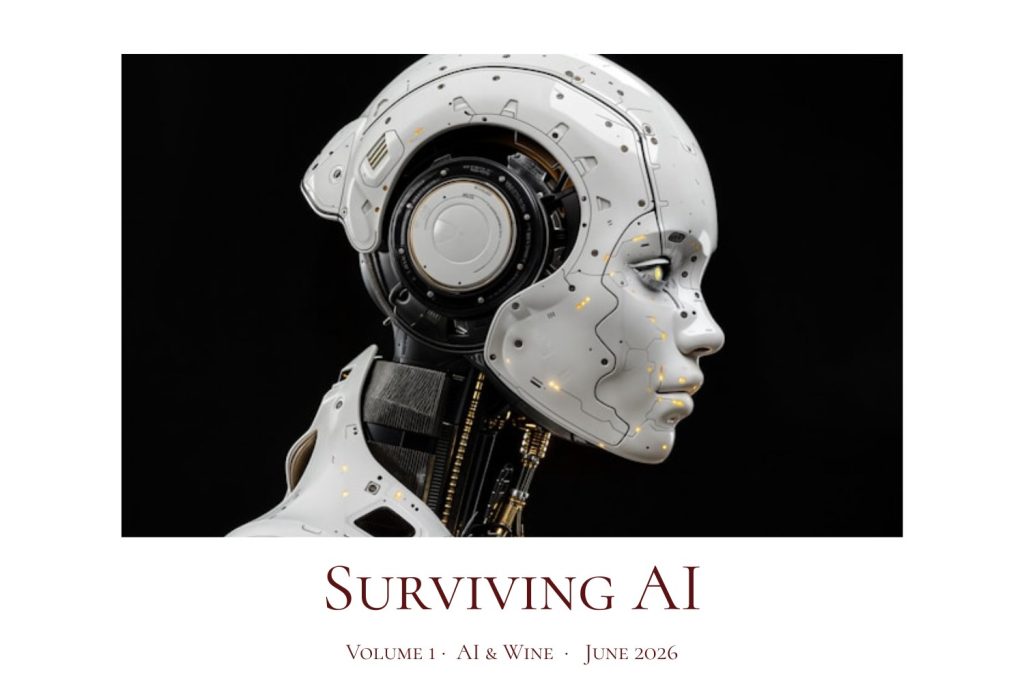
Simon J Woolf sets out his stall on how wine writers will ultimately survive AI, and even thrive from it. While it will not make us redundant – far from it – we need to work out how it best fits into our workflows, without allowing it to do the writing, which remains our greatest strength, he opines.
It takes a brave person to stand up in front of six publishers and ask them whether they would consider an AI generated manuscript. But during a panel discussion at this year’s London Book Fair, a delegate did exactly that.
The woman who posed the question had a specific use in mind. She suggested that AI could enable a non-native speaker – such as herself – to write something more accomplished in English. This did not resonate with the panel. Paige Allen, director of self-publishing imprint IngramSpark, implored her to employ a skilled human translator instead.
We all know how this ends. Faced with the cost of hiring a professional versus the price of a sandwich to buy a month’s ChatGPT subscription, which starving author wouldn’t go for option B? Let’s reframe that in wine: which time-poor salesperson or lexically-challenged marketeer hasn’t succumbed to the temptation to let AI write their back labels, their shelf-talkers or even their entire website?
These are rhetorical questions. Machine generated content is everywhere. Often, it is functional and expedient. But in virtually all cases, it is mediocre compared to the best work of a highly-skilled human. Why is this?
When graphic and photo editing packages such as Photoshop or Illustrator arrived on the scene in the late 1980s, they did not magically imbue us with a better sense of design or aesthetics, any more than Microsoft Word transformed us into accomplished novelists or Traktor gave us the pro-DJ skills of reading a crowd or selecting the best tracks. What these tools did was to democratise their industries. Instead of needing high-end hardware and software, you can now work as a graphics editor, a musician or a DJ with a modest initial investment and a mid-priced laptop.
None of these innovations replaced human creativity. Neither does AI, even if it is currently touted as a miracle solution with superhuman capabilities. AI tools have strengths and weaknesses, and just like any other piece of software they require a skilled operator to yield the best results. Understanding their pros and cons is, to my mind, a better strategy than yielding to an irrational or uninformed fear of the unknown.
The technical background
Modern AI platforms have their roots in neural networks, which are mathematical models developed to mimic our brain functions. Our biological neural networks consist of hundreds of thousands of interconnected neurons, which together are capable of processing complex tasks. The digital version, first proposed as a type of machine learning in the 1930s, saw rapid development from the 1980s and on.
Large Language Models, or LLMs, are a specific type of neural network on which all the major AI platforms are based. LLMs can be thought of as massive databases, where each bit of content has been tokenised and linked. The key innovation with LLMs is their support for natural language processing. In other words, they can be used to interact with a human in contexts such as via chatbots or AI agents like ChatGPT.
Google Translate is an easy to understand example of an LLM. When you ask it to translate from one language to another, this is done predictively based on the frequency of the same words and phrases appearing in the LLM. Google Translate has no innate knowledge of how languages work, yet it is far more reliable than me when it comes to German case endings. It can compare my text with a billion other examples in seconds, enabling it to predict the correct option.
There are two very important takeaways:
1. LLMs, and thus all modern AI platforms, must be trained on pre-existing content, the vast majority of which was created by humans. In other words, there is no AI content without human authors.
2. Intelligence is a misleading word, because LLMs and the AI platforms based on them have no cognisance. They are not capable of independent thought, but they can outrun us due to their vast amounts of processing power.
Weaknesses
Once you understand the underlying construct of LLMs, it should be clear that AI isn’t able to create or be original. It cannot come up with a new way of using language, an imaginative analogy for describing wine or a fresh narrative device based on some form of popular culture. All it can do is summarise and imitate content that was pre-existing at the time you requested its help.
If you are lazy, this doesn’t present a barrier. You could ask ChatGPT, as I just did, to write you 500 words on the Medoc, in the style of Andrew Jefford. The result seems convincing at first, but if you start to hack it apart you’ll see that it’s full of vagaries and cliches. It’s just not as good as the real thing. Welcome to AI. Welcome to a world where anything can be created faster and cheaper, but not better.
This is where the ethical discussion of AI usage in writing breaks down. If you want to excel at your craft, to refine your individual voice and to be known as an exceptional writer rather than just a subject matter expert, you will never use AI to write your prose. Canadian wine critic Natalie Maclean wrote in a recent article that “writers who can detect algorithmically generated fiction will become the most valuable critics in the industry.” However, I am not sure I agree. Tomorrow’s readers – if not today’s – will instinctively recognise machine generated writing, and reject it.
If you want to compete for the ever-dwindling attention span of most readers, your writing had better be amazing. The average reader may not consciously know why they abandon one article after the first two sentences yet read another right to the end. But it is largely down to the writer’s ability to be engaging, concise and clear – something that takes persistence and practice to achieve.
AI generated text invariably starts out pedestrian, overly verbose or hackneyed. You could spend hours prompting it to improve itself. But then you might as well write it yourself. So don’t let AI near your words. That doesn’t mean you have to be a Luddite though.
Strengths
AI is your friend when you need to complete a serious research task. Provide it with a dozen impenetrable academic papers, and it will deliver you a concise summary. Ask it to highlight differences in approach or outcome, and it will happily oblige without needing coffee first.
AI will always be faster than you in compiling and summarising. It is hard to beat for background research. However, AI also hallucinates. If there is insufficient content, the LLM will still try to build connections, but they could end up being wrong or even non-existent. There are times when I prefer a good old-fashioned Google search. I can make up my own mind about the source, rather than having to go through the entire summary checking AI’s homework.
By way of example, I asked ChatGPT to write a tasting note for one of my favourite wines – Seven Row’s Black Label 2025. The problem? This vintage won’t be bottled until next year, so there is no way of knowing how it will taste. ChatGPT had no qualms telling me that “The 2025 edition of Black Label feels like the most poised and transparent expression of the wine yet – still unmistakably wild at heart, but with a newfound precision running through it.”
Several colleagues told me they use AI tools to help proof and edit. There are real benefits here, especially for writers who self-publish and don’t have the luxury of working with an editor. But I’d like to repeat my earlier advice – don’t let AI near your words. Ask ChatGPT or Gemini how you could make your article more readable, more concise, more compelling. Pick and choose from the recommendations but then make the edits yourself. AI will suck the life and soul out of your prose if you let it near a single sentence.
The future
AI platforms are the latest in a long line of technological advancements which have been feared, denounced and ultimately embraced. Those that have had a profound effect on writers include the typewriter, the internet and the Nespresso machine. Few of us are enthusiastic about going back to the quill pen, or having to sit in the library all day photocopying source material. Technology usually makes life more convenient, even if it removes some of the romance. I can live without a rubbish bin full of crumpled first drafts.
Writers will, over time, figure out how AI best integrates into their workflows. Those that take too many shortcuts will lose their readers and perhaps their bylines. There is no room for mediocrity, but the uniquely human desire to imagine, to dream and to create will never die. Write your tasting notes as sonnets, tell me a story I’ve never heard before, surprise me, make me salivate, make me laugh or make me cry.
You will leave AI in the dust.
Main image photo by Gabriele Malaspina.