
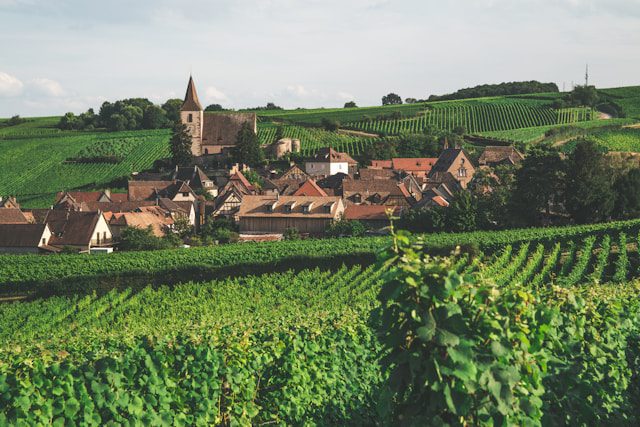
Sue Eames scopes and scans Alsatian soils, studying how the different grapes varieties perform in them, and also senses the strong shift to organic and biodynamic farming.
Back in March, I was lucky enough to be invited on the Association of Wine Educators’ visit to Alsace, and found it be a region that has changed dramatically since when I last visited in 2022. We learnt so much about how the different varieties interact with the vast and varied soils of the region and what they bequeath to the wine.
Alsace has always been a region with a high percentage of organic and biodynamic vineyards, but I noticed a big move this time: young winemakers taking over and making more natural wines, using canopy management, as well as wild yeasts, for their carefully made wines.
Our first visit was to the family-run Domaine Frédéric Mochel, where Guillaume Mochel, Frédéric’s son who took over running the estate in 2001, told us about the challenges of 2023, with both mildew and frost in the vineyard; the sparkle and spritz that the gypsum in his clay and limestone soils brings to his crémant; as well as his use of clay ‘jars’ for Riesling and Muscat in the winery to allow micro-oxygenation. We tasted some stunning wines including the amazing Altenberg de Bergbieten Riesling Grand Cru Cuvee Henriette 2021, with its spicy lemon and lime nose, and rich, seemingly everlasting length.
Au naturel for Lucas Rieffel
Next, we visited Domaine Andre & Lucas Rieffel, where Lucas has taken the bold decision to only make natural wines. He talked about the challenges brought about by climate change, and the problems getting his crémant to finish fermenting due to lower acidity and a higher pH. We tasted some great wines, including a lovely Riesling Wiebelsberg 2021 from old vines on white granite, with its notes of red apple and great acid structure.
This was followed by a fascinating presentation and tasting led by Adrien at Vincent Stoeffler, where father and son have decided to market both classic and natural wines, although nearly all the wines have skin contact during the direct pressing, and only a small amount of sulphur is used on the classic range. We were lucky enough to do a paired side-by- side tasting of the classic and natural ranges.
Orange and natural wine reconsidered
Despite never having been a fan of orange or natural wine, I was tempted and bought some of the stunning Feu Follet 2023 – made from a third each of Muscat, Pinot Gris and Gewurtztraminer, spending 5-8 days with whole bunch skin-contact, and then co-fermented to give a spicy nose with amazing length. Proof that, in my view, orange wines are best made with aromatic varieties.
The next morning took us to Domaine Marcel Deiss, whose vineyards are all co-planted and the wines are field-blended. Marie-Helene Cristofaro, estate manager and wife of Jean-Michel Deiss, talked us through their careful canopy management, as well as the way they manage Esca trunk disease by massal selection of rootstocks from their own vineyards.
Once again, stunning wines, and my preference was, rather surprisingly, for the orange wine, Gruenspiel – Le Jeu des Verts 2022, described as a wine of maceration and terroir. The vines are grown on very sticky, thick, black clay soil, giving amazing density. The wine spends three weeks in stainless steel before being moved to wooden barrels. It is bottled with no filtration and no sulphur, giving a bone-dry finish with a nose of red fruit, and raisins with amazing volume.
Agathe Bursin took us for a walk out into her beautiful vineyards on the hills behind the property. These are stunningly elegant wines from old vines. I loved the 2022 Riesling from Lieu dit Bollenberg, grown on limestone and fermented in stainless steel, giving a nose and palate of lime and petrol, and it was bone dry with stunning fruit on the very long finish. Agathe avoids the need for sulphur by fermenting in stainless steel, with no malolactic fermentation, thereby keeping the natural CO2.
A mulberry first
Next we met with Jerome, who, along with Jean-Philippe, took over at Domaine Schoenheiz, in Wihr-au-Val, in the Munster valley, in 2023, after spending time with the previous owners. He works with his right-hand woman Aude Olive, to continue making amazing wines whilst bringing his own personal touch. I was very excited to see my first mulberry barrel, alongside acacia and Burgundian oak.
We tasted some great wines and my personal favourite was the Gewurtztraminer Linsenberg, whereby we compared a 2019 from the previous winemaker with Jerome’s 2022, both made from grapes grown on granite and rose petals on the nose and lychee on the palate, culminating in amazing freshness on the finish.
Zooming in on Zind-Humbrecht
Our final day started with a presentation and tasting at Zind-Humbrecht with the inimitable Olivier Humbrecht MW, and where his son Pierre-Emile has now joined him. A fascinating talk ensued about all things soil, including chemical and granitic clay, canopy management, biodynamic influence, climate change and his use of Achilla milleflore (yarrow). Here there is no field blending, and Olivier shared his views on closures and PIWI grapes, as well as his experiments with Syrah and Corsican Sangiovese.
Rocking Rieslings
We compared Riesling grown on roche granitique (granite rock) and on roche calcaire (limestone rock) via the eponymously-named wines, and I fell for a sweeter wine: the Gewurtztraminer Grand Cru Hengst 2015, with its perfumed nose, delicious richness on the palate and fresh sweetness on the finish.
Back at Weinbach
It was a pleasure to return to Domaine Weinbach, where Eddy Leiber-Faller talked us through these amazing wines, as well his views on co-plantation, why they don’t make a crémant and also avoid a green harvest, as well as how Alsace Pinot Noir differs from Burgundy due to the higher acidity. We also discussed a general move to white wine and light reds, as consumers eat less red meat, and of course as an ex-banker, Eddy had interesting views on Mr Trump’s planned increase in US import taxes.
My own favourite was the 2023 Clos des Capucins Pinot Noir Villages, with its wonderful fruit and soft tannins. This wine spends 18 days on the skins, and is made with wild yeast, ensuring it is savoury and complex.
Our final dinner was an absolute treat, as Frederic and Christine had paired their wines from Domaine Pierre and Frederic Becht with the stunning food at Auberge Ramstein. Frederic explained how he has been trying a different yeast, which gives lactic acidity, since 2021, for his Gewurtztraminer from Stierkopf, and also that he uses a solera system for his crémant, allowing him to use more reserve wines.
All the wines were superb, with several having won gold medals at the Mondial des Vins Blancs in Strasbourg, where I am lucky enough to judge, but a special mention goes to Pinot Gris Stierkopf 2023. The grapes are harvested at the same time as Pinot Noir, have 3-4 weeks of skin contact and it is aged in stainless steel tanks, giving the wine a bone dry finish. Such an unusual wine.
Finally, a huge thanks goes to Linda Simpson for the great organisation; Nina Cerullo for her contacts; Helen Savage, who knows the region so well, and was on hand to create a real bond with the winemakers, for choosing menus for each evening that brought out the best of the wines; and of course to Foulques Aulagnon of the CIVA Comité Interprofessionnel des Vins d’Alsace, who was able to explain the incredible history of this area, which for me is so different from the rest of the French winemaking regions.